
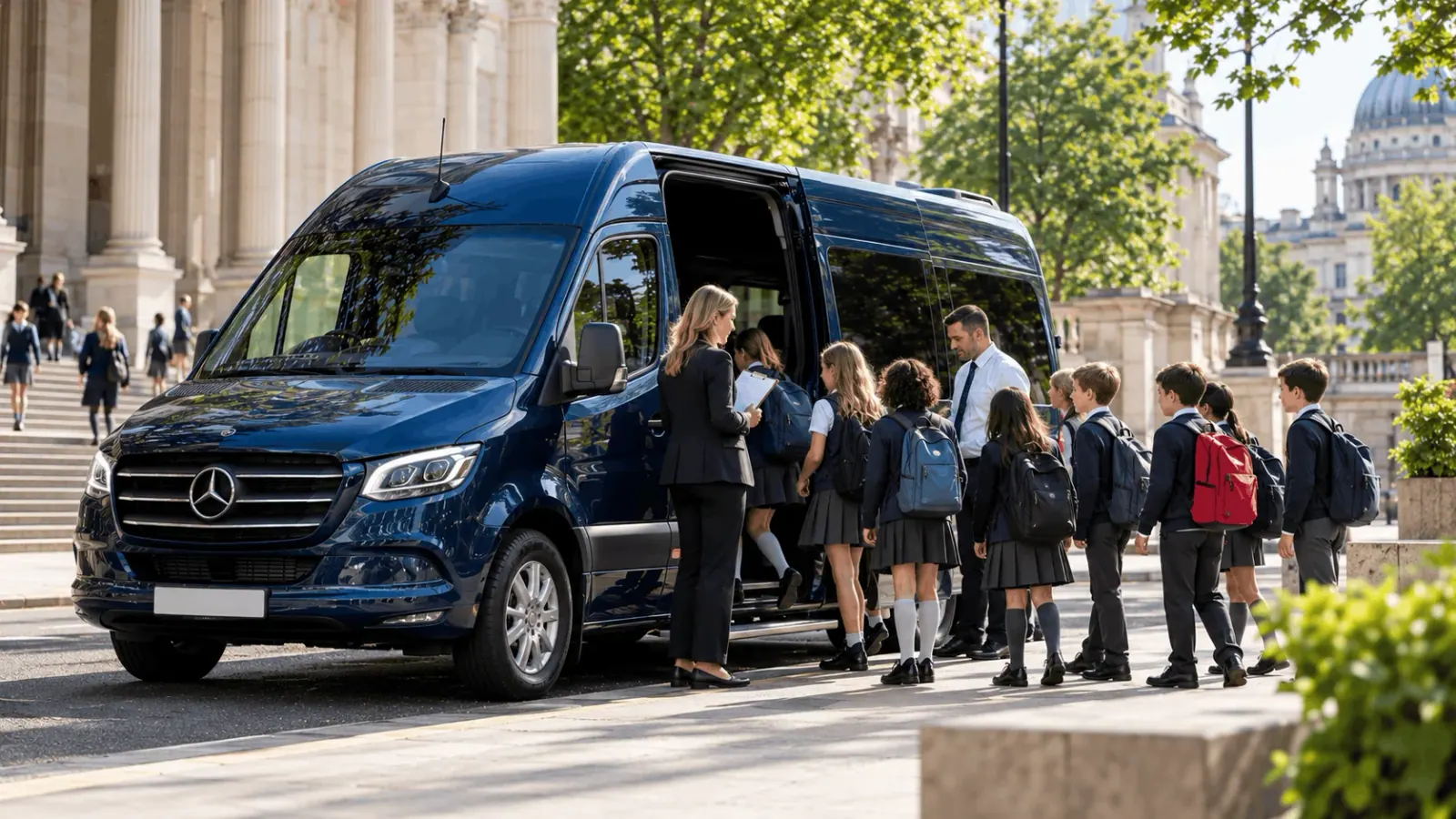
School Trip Minibus Hire in London
Minibuses and coaches with a driver for class trips, sports fixtures and residential visits, with every detail confirmed in writing for the trip leader.
Loading the quote form…
What does a school need from trip transport?
A vehicle that fits the class and the school gate, a driver who arrives early, timings that fit the school day, and every detail in writing for the trip plan.
For school trip minibus hire London schools come to us for one simple reason: the transport has to work so the learning can happen. Pupils need to leave after registration, arrive in time for the museum slot, and be back before home time, with staff free to supervise rather than worry about the journey.
We provide minibuses from 9 to 24 seats and coaches from 29 to 53 seats, all with professional drivers and seat belts on every seat. A 19-seat or 24-seat minibus suits a primary class with staff; a 29-seat midi coach suits a class of twenty-five and reaches many school gates a full-size coach cannot; a 49-seat coach suits a whole year group.
Every booking comes with a fixed written quote and a written confirmation of the pickup point, destination, timings and driver's details, which trip leaders can attach to their risk assessment and educational visit paperwork.
We work with primary, secondary and special schools, academies, nurseries and sixth-form colleges in every borough, from Hackney and Tower Hamlets to Ealing, Sutton and Enfield. Many book us term after term, and some ask for the same driver so pupils see a familiar face.
Choosing the vehicle for your class
By group size, including staff and helpers.
- A nursery outing of up to nine. A nursery outing minibus such as the 9-seater, with child seats discussed in advance.
- A small group of ten to sixteen. A 12 or 16-seat minibus, for sports squads or SEN groups.
- A primary class with staff. A 19 or 24-seat minibus.
- A class of twenty-five to twenty-nine. The 29-seat midi coach, with an underfloor hold.
- A year group. A 49 or 53-seat coach, or two travelling together.
Where London classes go
Popular educational visits by minibus and coach
The destinations we take school groups to most often.
South Kensington museumsSW7
The Natural History Museum, the Science Museum and the V&A sit side by side, so a South Kensington museum school visit is the most common trip of all. See Kensington and Chelsea.
The Tower of LondonEC3
Castles, the Crown Jewels and Tudor history for Key Stage 2 and 3. See City of London.
Royal Museums GreenwichSE10
The Royal Observatory, the Cutty Sark and the National Maritime Museum. See Greenwich.
Kew GardensTW9
Science and geography visits in the glasshouses and gardens. See Richmond upon Thames.
London ZooNW1
Animal and habitat topics in Regent's Park. See Camden.
West End theatresWC2
Matinees for drama and English groups, with a set-down near the theatre. See Westminster.
The school year and trip demand
When to book early.
Autumn termMuseum visits linked to new topics, and the start of the sports season.
Spring termTheatre trips, field work and sports tournaments.
Summer termThe busiest term: residential trips, sports days and end-of-year outings.
Exam seasonFewer secondary trips in May and June, more primary outings.
Day visit or residential?
The two kinds of school trip need slightly different vehicles.
Day visits
Day bags and packed lunches only, so a minibus works well for a class and reaches the school gate easily. The driver waits nearby or returns at the agreed time.
Residential trips
Each pupil brings a case and bedding, so a coach with an underfloor hold keeps the aisle clear and every seat free. The outward and return journeys are planned together.
Tell us the trip and we will suggest the right vehicle.
A Year 4 visit to the Natural History Museum
An example primary trip from Lewisham.
Boarding after registration
Twenty-eight pupils and five adults board the midi coach at the school gate. See Lewisham.
Head count and departure
The trip leader confirms the count with the driver.
Arrival at the museum's group drop-off
In good time for a 10:15 workshop.
Packed lunches and galleries
The coach parks in a coach area nearby.
Return
A second head count before setting off.
Back at school
Before the end of the day.
Timings are agreed with the trip leader and confirmed in writing.
Included in every school booking
Included
- A professional driver.
- Seat belts on every seat.
- Written confirmation of timings and the driver's details.
- An access check at the school and destination.
- A fixed written quote.
Ask us about
- Two vehicles for larger groups.
- Residential trips with a later return.
- Regular fixtures across a term.
- Smaller vehicles for SEN groups.
What to send for a school trip quote
The information we need.
- Pupils and adults The total number travelling.
- School address and boarding point So we can check access.
- Destination and booking time Including any workshop slot.
- Return time When the class must be back.
- Luggage or kit For residential trips and fixtures.
- Access needs Wheelchairs or other needs.
We reply with a written quote and the trip details.
A three-day residential trip, start to finish
Departure day
Cases in the hold
The class gathers in the playground with cases, sleeping bags and wellies. The driver loads the hold while staff take the register, and the coach leaves for the outdoor centre.
At the centre
The coach returns to London
Unless the programme needs a vehicle on site, the coach heads back and returns on the final day.
Return day
Collection and home
The coach collects the class and the luggage at the agreed time and brings everyone back to school, where parents are waiting.
School trip transport myths
HeardA class trip always needs a full-size coach.
In practiceMany classes fit the 24-seat minibus or 29-seat midi coach, which reach more school gates.
HeardPublic transport is simpler for a class.
In practiceManaging thirty pupils through stations is hard work and adds risk.
HeardStaff have to drive the school minibus.
In practiceWith us, a professional driver does, so staff can supervise.
HeardCoaches can stop outside any museum.
In practiceMost museums have a set group drop-off point, which we use.
Beyond the museum
Other school journeys we cover
School trip transport is about more than day visits.
Sports fixtures
A school sports fixture minibus takes a squad and its kit to matches, galas and tournaments, often on a weekday afternoon. See sports team travel.
Residential trips
Residential school trip transport takes a class and their cases to an outdoor centre or field studies centre, and collects them at the end. A midi coach or full-size coach with a luggage hold is best.
Secondary school coach trips
A secondary school coach trip to a university open day, a geography field site, the Houses of Parliament or a theatre. See coach hire with driver.
Special educational needs groups
Small groups with additional needs often travel best in a smaller minibus. Tell us about any needs, wheelchairs or mobility aids, and we will confirm which vehicle suits.
End-of-year outings
Theme parks, the coast and leavers' trips in the summer term.
London road rules
School gates, museum drop-offs and stopping rules
Where a school vehicle stops matters for safety.
At the school. We agree a safe boarding point: the playground gate, a staff car park or a nearby road the school recommends. Full-size coaches often need a main road.
At museums. Most major museums have a group or coach drop-off point. We confirm it before the day.
At theatres. West End streets have little stopping space, so pupils are set down at an agreed point nearby.
Red routes. Main roads marked with red lines where stopping is banned or restricted. We never plan a pickup on one.
During the visit. The vehicle parks in a coach area or returns at the agreed time.
Tell us about your school entrance and we will check access for the right vehicle.
Where school journeys begin
We agree a safe boarding point at every school.
- Playground gatesIdeal for minibuses on quieter roads.
- Staff car parksWhere the space allows a vehicle to turn.
- Main roads near the schoolOften needed for full-size coaches.
- Sports groundsFor fixtures that start at the playing fields.
- Nurseries and children's centresFor small outings.
Why schools book a driver
Freeing staff to focus on the pupils
Many schools have their own minibus, but driving it takes a member of staff away from supervising the class and requires the right licence and training. Public transport means managing thirty pupils through stations and onto crowded trains, with the risk of losing someone at a platform.
Educational visit transport in London with a professional driver removes both problems. Staff sit with the pupils, the driver handles the route, the parking and the timings, and the class travels door to door.
It also makes the day more predictable. The vehicle leaves when the class is ready, arrives in time for the booking slot, and is waiting for the return, so the visit can run to plan.
For primary school minibus with driver bookings, we can usually stop right at the school gate, which makes boarding quick and safe.
Questions trip leaders ask
OrganiserWe have twenty-six pupils and four adults. Which vehicle?
UsThirty passengers is one more than the midi coach, so a 49-seat coach, or a midi coach and a minibus together.
OrganiserCan you send the booking details for our risk assessment?
UsYes. We confirm the times, addresses, vehicle and driver's details in writing.
OrganiserOur school is on a narrow street. Will a coach fit?
UsPossibly not. We will check, and the midi coach or a minibus may be better.
OrganiserCan the driver wait while we are in the museum?
UsYes, in a nearby coach area, or return at the agreed time.
For trip leaders
Paperwork that supports your risk assessment
Trip leader risk assessment transport details, set out clearly.
Every educational visit needs a plan, and the transport is part of it. We confirm in writing the pickup point at the school, the departure time, the destination and its drop-off point, the return pickup point and time, the vehicle size and the driver's name and contact number.
That gives the trip leader and the educational visits coordinator what they need for the risk assessment and the parent letter. If anything changes, such as a later museum slot or a different number of pupils, we update the confirmation.
On the day, the driver arrives early, works with staff on the head count before departure and before the return, and keeps in touch with the trip leader by phone.
We are happy to answer any questions your school's procedures require about the booking.
Transport terms for educational visits
Words that appear in our school confirmations.
- Boarding point
- The agreed place at school where pupils get on and off the vehicle.
- Group drop-off
- The point at a museum or attraction where school vehicles may stop.
- Head count
- The check of every pupil and adult before departure and before the return.
- Midi coach
- A smaller coach of twenty-nine seats with a luggage hold.
- Return pickup
- The agreed time and place for the journey back to school.
From Inner London schools
Journey times to favourite school destinations
Approximate times outside the rush hour.
- South Kensington museumsabout 20–45 minutesDepending on the borough.
- Tower of Londonabout 20–45 minutesFrom most inner boroughs.
- Greenwichabout 25–50 minutesFrom central and east London.
- Kew Gardensabout 30–60 minutesFrom central and west London.
- Thorpe Park or Chessingtonabout 45–75 minutesFor summer-term outings.
- Outdoor centres in Kent or Surreyabout 1–1.5 hoursFor residential trips.
Leaving after the morning rush usually saves time.
From our blog
Guides for planning your School trips trip

Questions
School trip transport questions
What vehicles do you use for school trips?
Minibuses from 9 to 24 seats and coaches from 29 to 53 seats, all with professional drivers.
Do all seats have seat belts?
Yes.
Can you provide details for our risk assessment?
Yes. We confirm the timings, addresses, vehicle and driver's details in writing.
Can a coach reach our school gate?
It depends on the street. A midi coach or minibus often reaches places a full-size coach cannot.
Where will you drop us at the museum?
At the museum's group or coach drop-off point, which we confirm in advance.
Can you take a class on a residential trip?
Yes. A coach with a luggage hold is best for cases and sleeping bags.
Can you take sports teams to fixtures?
Yes, including weekday afternoon matches and tournaments.
Can you help with pupils who use wheelchairs?
Mention it when you enquire and we will confirm in writing which vehicle can take the wheelchair.
Will the driver help with the head count?
Yes. The driver works with staff on the count before departure and before the return.
How early should we book for the summer term?
As early as possible, ideally at the start of the school year.
Can you take two classes on the same day?
Yes, with a full-size coach or two vehicles travelling together.
Can parents meet the vehicle at the end of a residential trip?
Yes. We return to the agreed point at school at the confirmed time.
Can you take sixth-formers to a university open day?
Yes, in London or further afield. See nationwide travel.
Can we book the same driver for regular fixtures?
Where we can, yes. Mention it when you book.
Can the vehicle collect pupils from two school sites?
Yes, if both have a safe boarding point. We plan the order and confirm the times.
Do you take groups to the Houses of Parliament?
Yes. We set down at an agreed point nearby, as stopping in Westminster is restricted.
Can you plan a trip around a museum workshop time?
Yes. Send the workshop or entry time and we set the departure to arrive with a margin.
Do you cover nursery outings?
Yes. Tell us the children's ages so we can discuss suitable seats.
Planning a school trip?
Send the number of pupils and adults, the school address, the destination and the times. We will reply with a written quote and the trip details for your paperwork.